Why High-Pressure Spray Guns Produce More Overspray Than Low-Pressure Models
High-pressure spray guns can atomize paint aggressively, but that same energy is the main reason they produce more overspray than low-pressure models. In automotive refinishing, overspray is not only a material cost issue. It also affects booth cleanliness, masking quality, edge control, color blending, and final clearcoat appearance.
When atomizing pressure is high, paint particles leave the air cap at greater speed. These fast-moving droplets hit the panel, and part of the spray cloud rebounds instead of staying on the surface. This rebound is especially obvious on curved panels, bumper corners, door edges, and wheel arch profiles. A lower-pressure gun slows down the coating cloud and improves transfer efficiency.
The second reason is turbulence. High-pressure air produces more disturbance around the fan edge. The fan may look wide and powerful, but the outer zone often contains dry particles. These particles float away from the workpiece and settle on adjacent panels or booth filters. A properly adjusted low-pressure setup can deliver Uniform coverage with less airborne contamination.
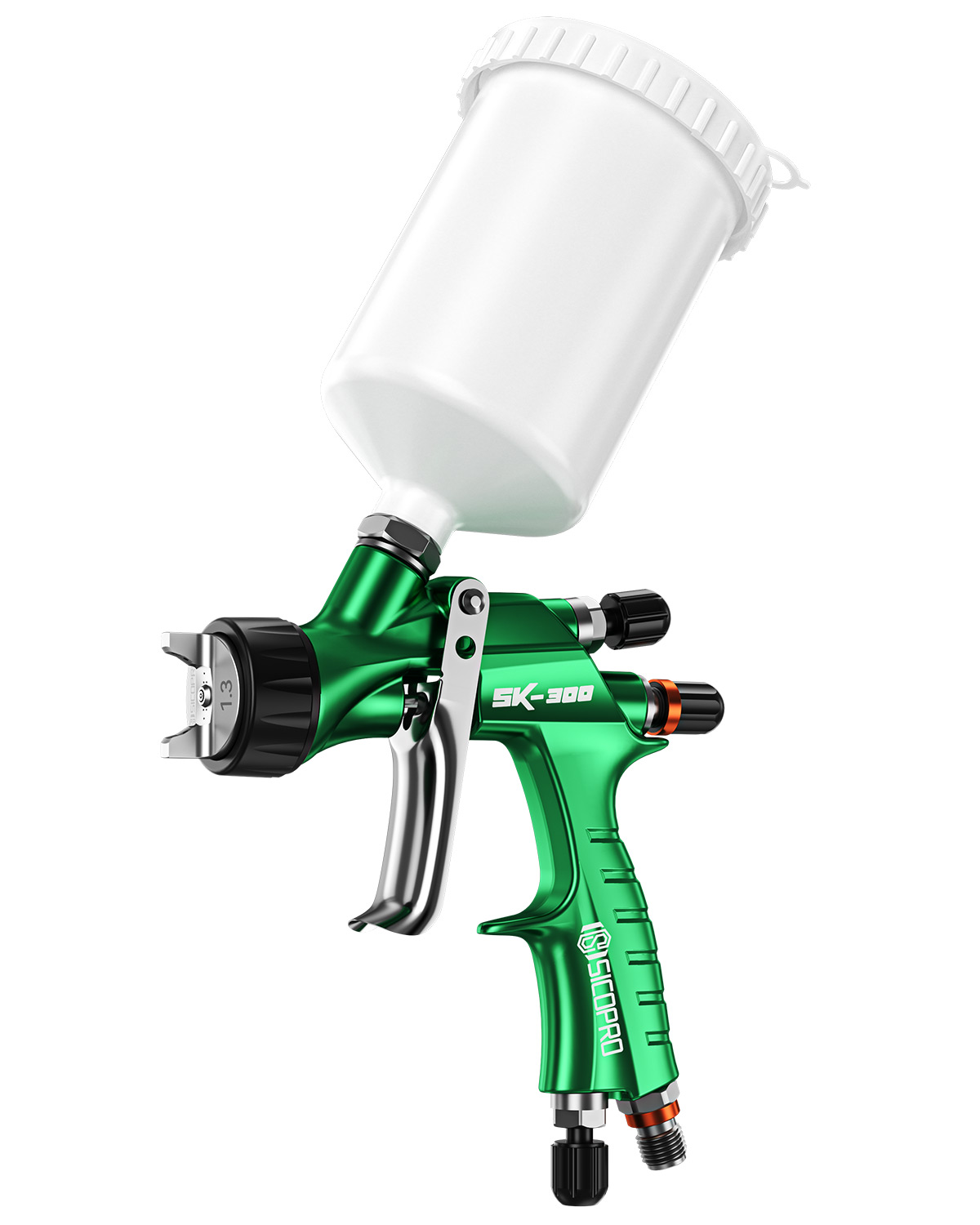
For painters comparing equipment, a low-pressure option such as a low-volume or low-pressure gun is often better for controlled repair work. When adjusted correctly, LVLP Spray Gun Non-spattering behavior helps reduce start-stop defects and keeps material flow stable. This is valuable for basecoat blending, spot repair, bumper refinishing, and small panel work.
However, low pressure does not mean poor atomization. The key is balance. The painter must match viscosity, nozzle size, inlet pressure, fan width, and fluid output. If material is too thick, even an air spray gun will struggle to break it into fine particles. Always check the paint manufacturer’s technical data sheet for reduction ratio, nozzle recommendation, and spraying pressure.
To reduce overspray on a high-pressure gun, start by lowering inlet pressure in small increments while testing the pattern. Spray on masking paper and inspect droplet size. The pattern should be wet and even, not dry at the edges or heavy in the center. Then reduce fan width slightly. An excessively wide fan creates more edge turbulence and wastes paint beyond the panel.
Spray distance is equally important. Holding the gun too far from the surface allows droplets to dry before landing, increasing dusting and poor adhesion. Keep a controlled distance and move at a consistent speed. For most automotive topcoat work, maintaining a stable distance is more important than spraying quickly.
Low-pressure models are especially useful when the job requires Uniform coverage without unnecessary material loss. They help control film build on narrow repair zones and reduce the risk of dry spray on blend edges. When a painter wants cleaner transfer, lower bounce-back, and better control, LVLP Spray Gun Non-spattering setup is often the more efficient choice.
SEO Keywords
paint spray gun, automotive spray gun, LVLP spray gun, HVLP paint sprayer, air spray gun, auto body paint gun, car paint gun, refinishing spray gun, professional spray gun, pneumatic paint sprayer, gravity feed spray gun, compressed air paint gun, paint gun for car, vehicle spray gun, automotive paint sprayer, detail spray gun, touch up spray gun, paint spray tool, high pressure spray gun, low pressure spray gun, non-spattering spray gun, uniform coverage spray gun, automotive refinishing tool, car body repair shop, collision repair painter, spray booth technician, coating application specialist, industrial coating gun, basecoat spray gun, clearcoat spray gun, primer spray gun, air cap cleaning, spray gun needle cleaning, spray pattern adjustment, fan width adjustment, paint atomization control, overspray reduction, deep cavity spraying, flammable coating spraying, professional automotive refinishing
READ MORE