By Joan
Fine pitting, micro-craters, and an irregular granular finish are not always contamination defects. In a professional spray booth, partially blocked air-cap ports can distort the horn air, destabilize the atomization envelope, and create local turbulence that drives coarse droplets into the wet film. The defect may resemble solvent pop or dust nibbing, but the pattern often follows the spray fan and becomes more visible at panel edges or during slower passes.
1. Separate airflow defects from coating defects
Begin with a clean masking-paper pattern test. Use the same coating, viscosity, pressure, and distance used on the vehicle. A distorted fan, one heavy horn, a crescent-shaped edge, or intermittent pulsing indicates a gun-side issue. If the defect remains after changing material and cup, focus on the air cap, nozzle seating, gun-body passages, and air supply rather than adding reducer.
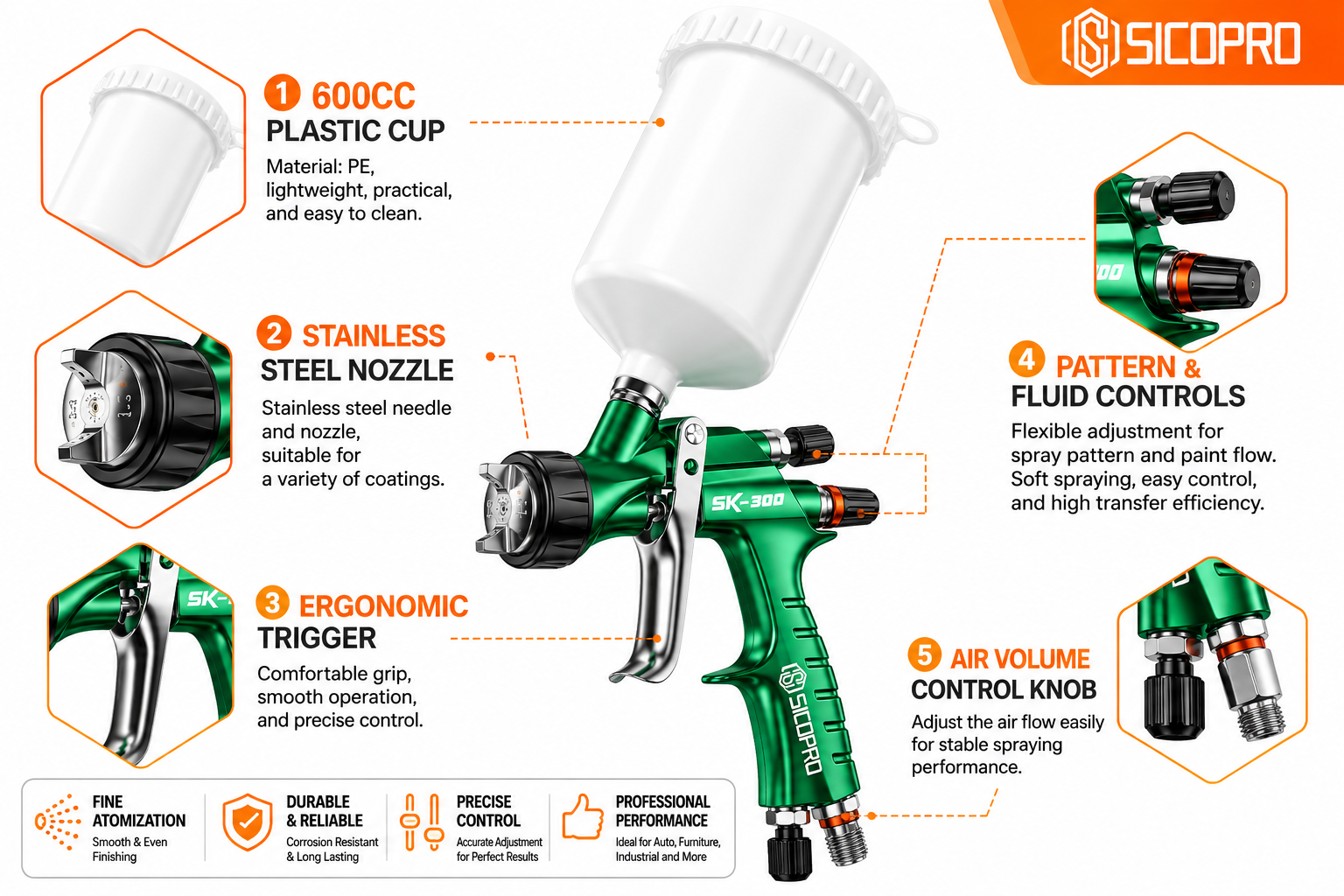
Confirm dynamic inlet pressure with the trigger fully open. Static gauge readings are insufficient because a restricted hose, undersized coupling, or saturated filter can drop pressure during flow. A lvlp spray gun Professional Automotive Tools configuration still requires stable air volume; low consumption does not mean the gun can tolerate erratic delivery.
2. Remove and inspect the air cap correctly
Depressurize the gun, drain the cup, and wipe the exterior before disassembly. Remove the retaining ring and lift off the air cap without striking the nozzle. Hold the cap under a bright inspection lamp. Examine the central atomizing holes, both horn ports, and all auxiliary holes around the face.
Compare left and right horn ports for equal diameter and shape.
Look for dried clearcoat, primer residue, polishing compound, or tape adhesive.
Check for impact damage, burrs, or ovalized holes caused by metal picks.
Inspect the sealing face for dried material that prevents concentric seating.
Verify that the air cap and fluid nozzle are the correct matched set.
3. Clean without enlarging the ports
Soak only the removable cap in the cleaner approved by the gun manufacturer. Use a soft-bristle brush and nonmetallic cleaning needles sized for the ports. Never force welding-tip cleaners, drill bits, or hardened steel wire through the holes. Enlarging one horn port changes air velocity and permanently shifts the fan.
Blow through each passage with clean, regulated air from the rear side. On an air spray gun, also inspect the baffle and front air-distribution ring. Replace damaged seals rather than compensating with higher pressure.
4. Reassemble and verify
Seat the cap concentrically and tighten the retaining ring only enough to hold position. Perform a dry airflow check, then repeat the one-second paper test. Rotate the air cap 180 degrees: if the heavy side rotates with the cap, the cap remains defective; if it stays in the same position, inspect the nozzle, baffle, or internal air passage.
Finish with a controlled test-panel application. Maintain 150–180 mm distance, 70% overlap, and constant speed. If pitting disappears and droplet size becomes uniform, document the cleaning method and inspection interval. The next linked process is large-nozzle primer application and material-flow control, covered in Article 3.
SEO Keywords
air-cap cleaning, spray-gun turbulence, paint-surface pitting, horn-port inspection, atomization defect diagnosis, automotive refinishing, spray-pattern correction, nozzle and air-cap matching, compressed-air stability, paint-gun maintenance, micro-crater troubleshooting, body-shop spray equipment.